
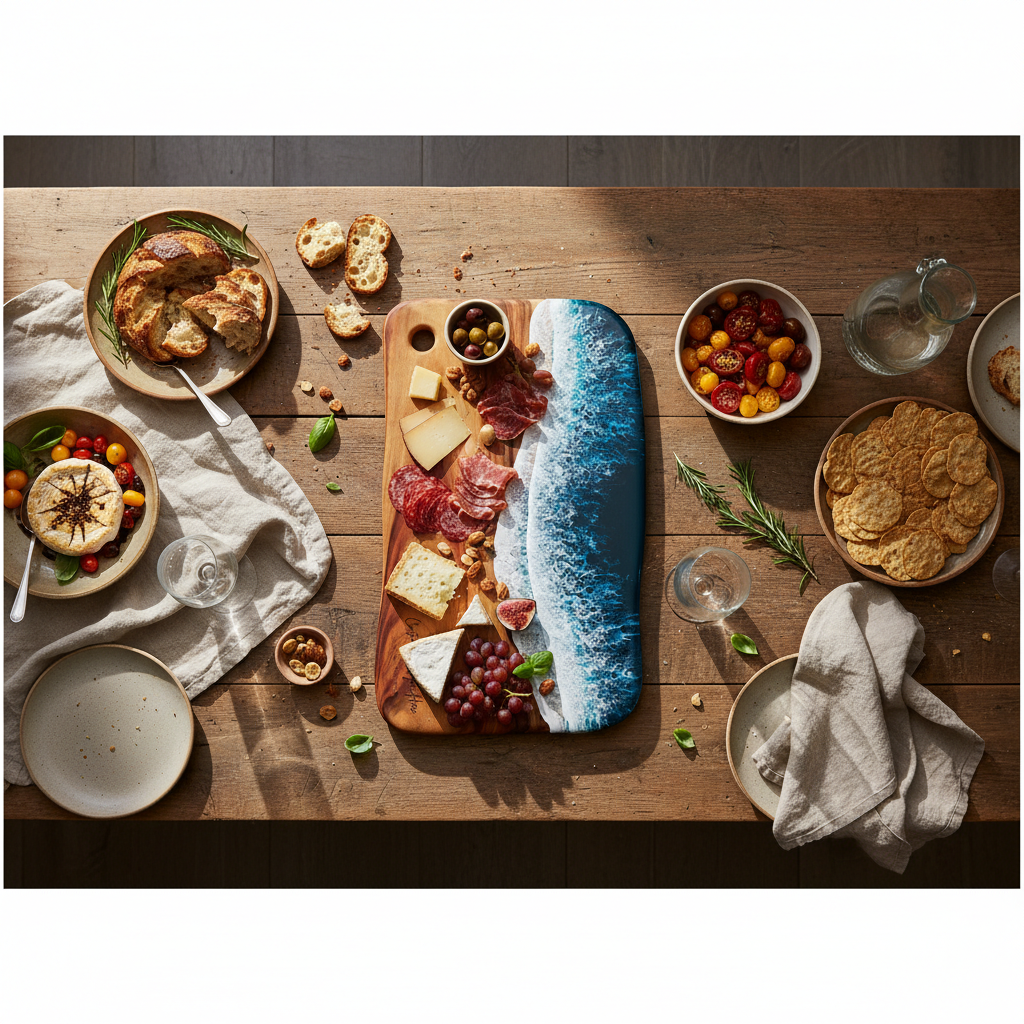
There is a moment in every pour when the resin decides what it wants to be. We can guide it. We can coax it. But the final pattern, the way the colour shifts and the lace cells form along the edge of the Camphor Laurel, that belongs to the resin and the timber together. No two pours have ever looked the same in over a decade of making handmade homewares in our Sunshine Coast studio. And that is the point.
We get asked sometimes whether we will scale up. Whether CNC machines could carve the timber faster. Whether moulds could standardise the resin. Whether automation could make everything more efficient. The answer is always the same. We could. We will not.
This is not stubbornness. It is a decision about what kind of objects deserve to exist in a world already full of things.
What Happens in 47 Touches
Every board that leaves our studio has been handled roughly 47 times by a real person. That is not a poetic estimate. It is an approximate count of the discrete actions between a raw slab of Camphor Laurel arriving and a finished piece being wrapped for shipping.
It starts with timber selection. Each slab is assessed for grain direction, natural character marks, structural integrity, and how well it will partner with resin. Some slabs are rejected here. Not because they are flawed, but because the grain pattern does not suit what we need. After 12 to 24 months of controlled seasoning, the timber is ready for carving.
Then comes shaping. Our boards are carved from single pieces of Camphor Laurel. No laminated strips, no glued joints, no composite fillers. One slab becomes one board. The carpenter reads the grain as they work, adjusting for knots, colour variations, and the natural movement of the wood. This is not a step that a preset cutting programme can replicate, because every slab is different.
Sanding is next. Multiple passes at progressively finer grits until the timber surface is smooth enough to hold against your cheek. Then the resin preparation: mixing, colouring, and the pour itself, which is the most intuitive stage of all. The resin is hand-guided with heat and movement. The colours are layered. The lace cells are encouraged but never forced. Then curing, finishing, quality checks, laser engraving if the piece is personalised, and finally, wrapping.
Forty-seven touches. Each one a small decision made by a person who has done this thousands of times and still pays attention.
The Automation Question
We think about this honestly. Not every handmade claim deserves reverence. Some things should be automated. If a machine makes a better, safer, more consistent version of something, use the machine. We are not romantics about labour for the sake of it.
But here is the distinction we keep coming back to. Automation works beautifully for precision. For repeatability. For producing identical units at scale. It does not work for objects whose entire value comes from being unrepeatable.
Our Large Resin Cheese Boards are not valuable because they meet a specification. They are valuable because no specification could produce them. The way the Seascape resin moves across a particular piece of Camphor Laurel with its particular grain, its particular knots, its particular story of growing in Queensland soil for decades before being harvested as an invasive species and given a second life in our studio. That intersection of material and craft is what makes each one singular.
A mould could approximate the shape. A printer could simulate the grain. But the thing that makes someone pick up a board and say "this one, this is the one" cannot be manufactured. It can only be made.

What We Actually Protect (and What We Do Not)
We are not precious about everything. We use technology where it genuinely serves the work. Our laser engraver is a machine, and it does its job with a precision that hand-carving cannot match. Our shipping systems are automated. Our inventory tracking is digital. We are not running a heritage museum.
But there are specific stages in the making process that we have drawn a line around. These are the stages where human judgement, human intuition, and human imperfection create the qualities that matter most.
Timber selection. A person needs to hold the slab, turn it, feel the weight distribution, read the grain with their eyes and their hands. Software cannot assess character.
The resin pour. Every pour is a conversation between the maker and the material. Temperature, humidity, pigment density, pour speed, heat application. These variables interact in ways that make each outcome genuinely unrepeatable. A skilled pourer does not follow a formula. They respond to what the resin is doing in real time.
Quality assessment. The final check before a piece ships is a person holding it, turning it under the light, running their fingers across the surface. Looking for anything that does not feel right. Not a tolerance threshold on a sensor. A feeling.
These are the things we protect. Not because we are anti-technology, but because removing the human from these steps would remove the very thing that gives the object its worth.
Why This Matters for the Person Receiving It
We hear from customers regularly who tell us they can feel the difference. Not in a vague, sentimental way, but in a specific, physical way. The weight of a board carved from a single piece of timber. The depth of the resin when you hold it at an angle and light catches the layers. The slight variation in the edge where the carpenter followed the natural line of the grain instead of forcing it straight.
When you give someone a piece like our Gourmet Duo Gift Box, you are not giving them a product with a SKU. You are giving them something that took 47 touches to create, that could not have been made identically a second time, and that will outlast the occasion it was bought for by decades.
That is the quiet power of handcrafted objects. They carry evidence of their making. And evidence of making is evidence of care.

The Camphor Laurel Story (Because the Material Matters Too)
It is worth saying something about the timber itself, because this is not a generic "we use wood" story. Camphor Laurel is an invasive species in Australia, originally introduced from Asia as an ornamental tree. It spreads aggressively, displacing native flora and disrupting ecosystems across Queensland and northern New South Wales.
Every slab we use is sourced from trees that were being removed for environmental management. The timber is dense, aromatic, naturally antibacterial, and spectacularly beautiful when worked with skill. It is also abundant, which means using it does not create the ethical tension that comes with harvesting native hardwoods.
We season each slab for 12 to 24 months in controlled conditions before it is ready for carving. This is slow work. But it is the only way to ensure the timber is stable, dry, and will not warp or crack after it becomes a finished piece. Some of our competitors skip this step. We never will, because a board that warps in six months is not a board worth making.
When someone asks about our Large Resin Paddle Board, this is the invisible story inside it. Years of seasoning. An invasive tree transformed into something that a family will use every weekend for the next twenty years. The sustainability story is not a marketing angle. It is just how we make things.

Frequently Asked Questions
What does "handmade" actually mean for The Fifth Design boards?
Every board is carved from a single piece of Camphor Laurel timber by a skilled carpenter, with resin hand-poured and guided individually for each piece. The only machine involved in the decorative process is our laser engraver for personalisation. All shaping, sanding, resin pouring, finishing, and quality checking is done by hand in our Sunshine Coast studio.
How long does it take to make one board from start to finish?
The total timeline from raw slab to finished piece is approximately 12 to 26 months, including the seasoning period. The active making process, from carving through to shipping, takes several days depending on the complexity of the piece and whether it includes personalised engraving.
Why is Camphor Laurel a good choice for handmade homewares in Australia?
Camphor Laurel is an invasive species in Queensland and New South Wales, so using it does not create the ecological concerns associated with harvesting native hardwoods. The timber itself is dense, naturally antibacterial, highly aromatic, and produces stunning grain patterns. It is an environmental problem turned into a craft material.
Can I use a resin board for food preparation?
The Camphor Laurel timber side is designed for chopping and food preparation. The resin side is decorative due to the pigments and inks used in the colouring process. We recommend using the timber side for all cutting and serving the resin side with wrapped or dry foods for visual presentation.
How should I care for a handcrafted Camphor Laurel board?
Hand wash only with warm water and mild soap. Do not soak, and never put it in the dishwasher. Oil the timber side periodically with food-grade mineral oil or board butter to maintain the finish. Store flat or upright. With proper care, these boards last for decades.
What makes handmade resin boards different from factory-produced alternatives?
Factory resin boards use moulds, which means every piece is identical. Handmade boards are poured individually, so the resin pattern, lace cells, and colour movement are unique to each piece. The timber is also different in each board, with its own grain, knots, and character marks. No two boards from our studio have ever been the same.
Do you offer personalised engraving on your handmade boards?
Yes. We laser engrave directly into the timber fibres, not onto a surface layer. This means the engraving is permanent and becomes more beautiful as the timber ages. Popular options include names, dates, family crests, and short messages. You can see engraving options on any product page in our shop.
We started The Fifth Design because we believed that the objects people gather around should carry the same intention as the gatherings themselves. That they should be made slowly, with real materials, by people who care about getting it right. That is not going to change. Not because we cannot change it, but because the work is better this way. And the people who choose our pieces can feel it.
Share:
Less But Better: The Case for Intentional Entertaining
How to Care for a Resin Chopping Board (So It Lasts a Lifetime)